Storage is where private cloud budgets often hide their biggest surprises. A low entry price can turn into years of extra labor, while a higher software bill can still save money if your team runs it well.
That is why the Ceph vs vSAN decision still matters in 2026. If you’re balancing VMware renewals, Kubernetes growth, and pressure to cut vendor spend, the better choice depends less on sticker price and more on how your platform will live day to day.
Architecture shapes the bill before licensing does
Ceph and vSAN start from different ideas. vSAN is hypervisor-native storage inside a VMware cluster, so it keeps data close to the VM and stays familiar to vSphere admins. Ceph is a distributed storage platform that can present block, file, and object storage across separate or shared nodes, which gives you more room to mix hardware and scale storage on its own.
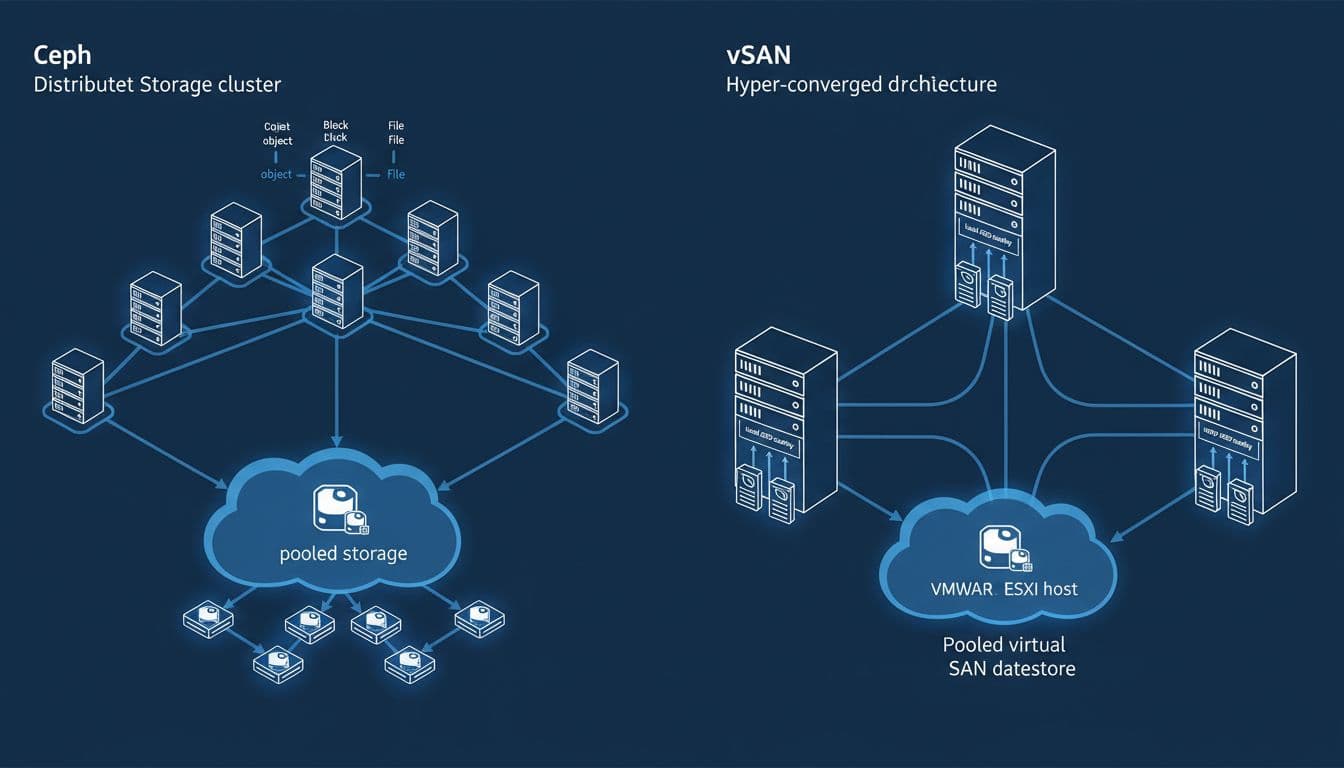
This quick comparison frames the tradeoff:
| Area | Ceph | vSAN |
|---|---|---|
| Licensing | Open-source core, paid support optional | Paid software, usually part of VMware spend |
| Hardware | Commodity servers, disaggregated designs | ESXi hosts with local disks |
| Scaling | Compute and storage can grow separately | Often adds compute and storage together |
| Ecosystem | KVM, OpenStack, Kubernetes, S3, file, block | VMware-first VM storage |
| Best fit | Mixed private clouds at larger scale | VMware-heavy teams that want simpler ops |
For buyers focused on long-term cost, that split matters. Ceph lets you re-use servers, buy from more vendors, and avoid tying storage growth to a hypervisor cluster. vSAN usually asks for a more consistent node design, but it pays you back with less architectural sprawl and fewer moving parts inside VMware.
So the first cost question is simple: do you want storage as part of the virtualization stack, or as a separate platform that can serve several stacks? Your answer drives the rest of the model.
Real TCO goes far beyond the license line
A vSAN quote is easier to model. You pay for VMware software, support, and the certified hardware pattern you choose. In 2026, many teams price vSAN as part of a broader VMware renewal, not as a stand-alone product, which can make budgeting clearer but also harder to separate from wider platform costs.
Ceph flips that equation. The software can be free, or you can buy enterprise support through vendors such as Red Hat or IBM. That looks cheaper at first, and it often is at scale. Still, TCO rises if you need more Linux, storage, and network skill than your team has today. Recent buyer feedback on TrustRadius shows this pattern well: lower software cost does not always mean lower operating cost.
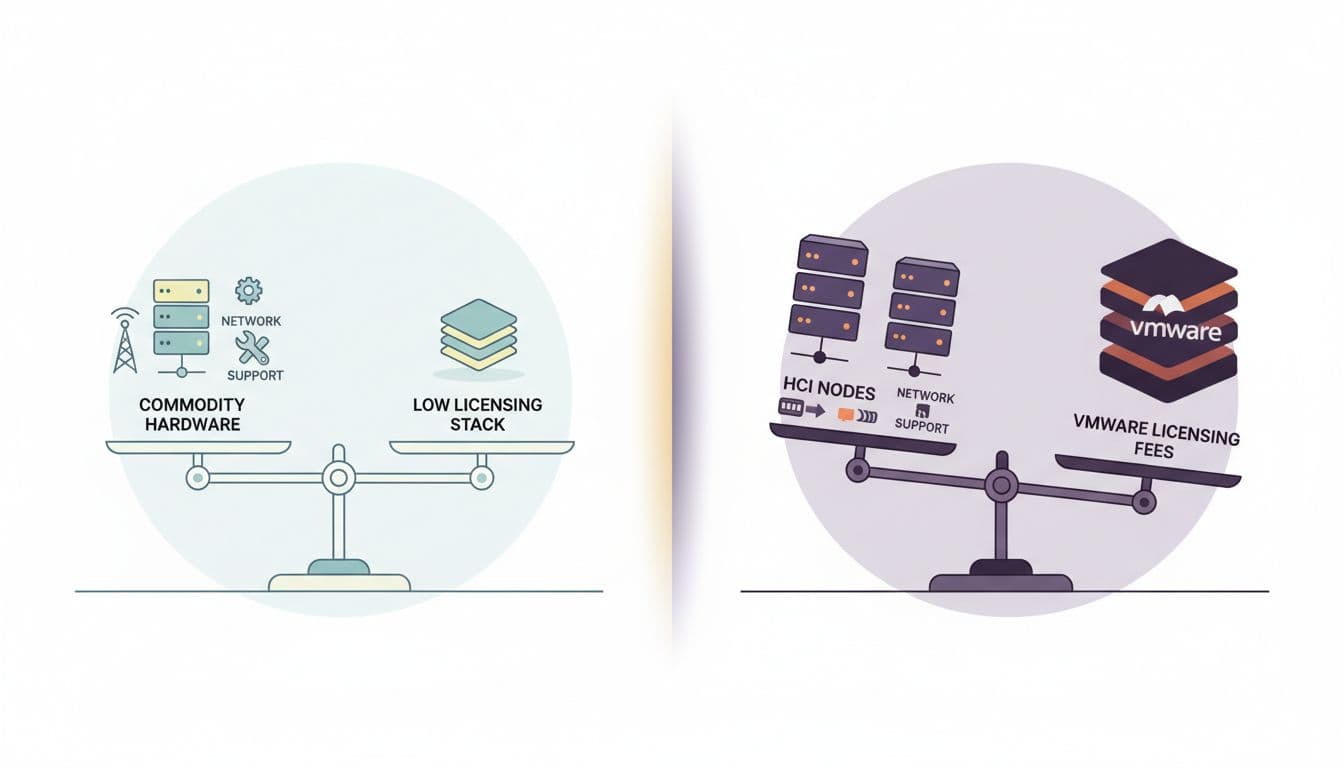
Hardware reuse is where Ceph often wins. If you already own healthy x86 servers and want to stretch their life, Ceph can cut capital spend. OpenMetal’s write-up on Ceph cost reduction highlights why commodity hardware and erasure coding can improve efficiency in larger private clouds.
But there is no free lunch. Ceph can demand faster east-west networking, careful disk class planning, and more tuning during growth or rebuilds. Meanwhile, vSAN may carry more software cost and host CPU overhead, yet it often reduces training, tooling, and upgrade friction because admins stay inside vCenter.
If you need to hire a Ceph specialist to keep the platform healthy, the license savings can disappear fast.
Support also changes the math. vSAN support is straightforward for VMware-centric shops. Ceph support ranges from community help to full enterprise contracts, which gives flexibility but also puts more responsibility on the operator.
Day-2 operations decide who actually saves money
Day-2 work is where many private cloud plans go off course. vSAN is easier for teams that already live in vSphere. Policy-based storage, built-in health views, and familiar lifecycle tooling reduce the number of handoffs between virtualization, storage, and network teams.
Ceph asks more from operations. You need people who can read cluster behavior, plan recovery domains, and stay on top of upgrades and balancing. ReadySpace’s comparison makes the same point from a buyer angle: lower licensing can come with higher staffing and network costs.
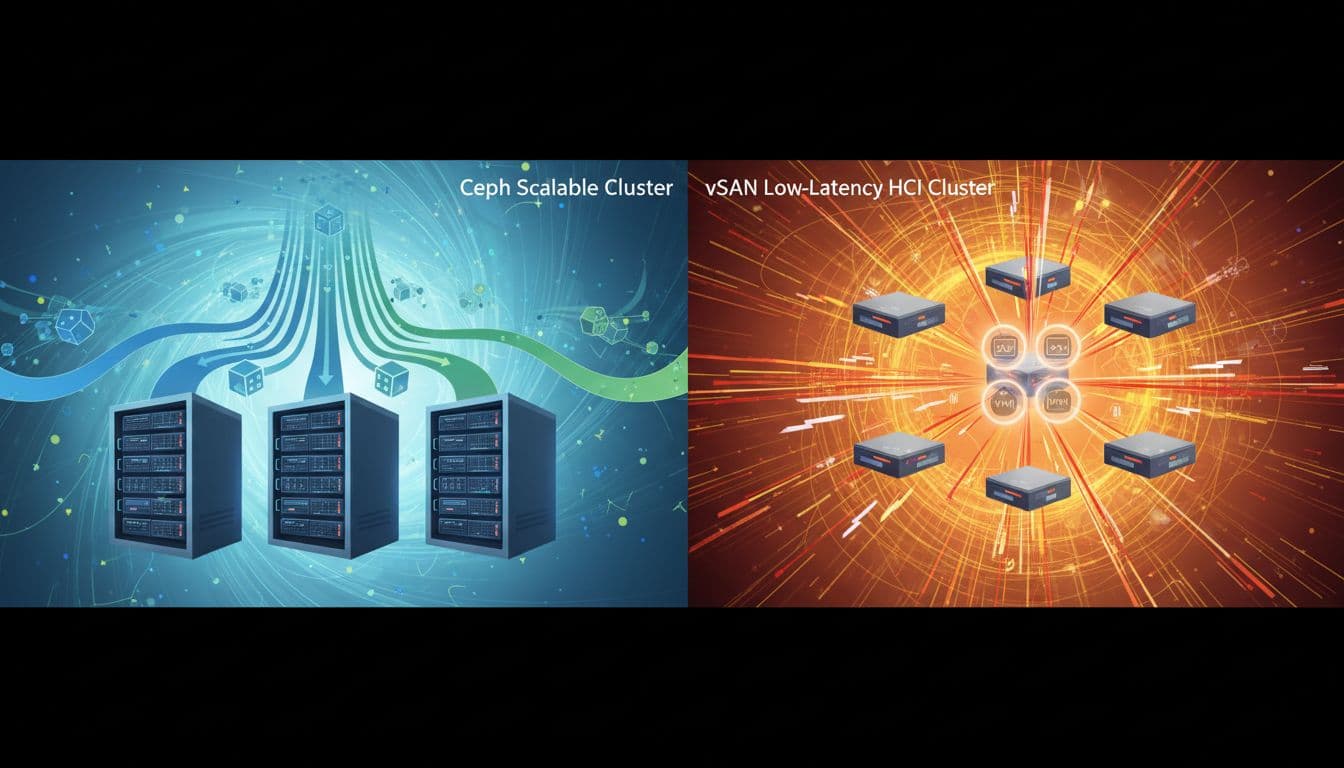
Performance is also workload-dependent. vSAN usually has the edge for low-latency VMware VM workloads, especially databases and VDI inside well-sized clusters. Ceph can perform very well too, but it rewards careful design more than default settings. In exchange, it scales farther across mixed workloads and larger storage pools, and it can present object, file, and block from one platform.
Both platforms protect data well. vSAN gives you RAID choices, fault tolerance policies, and stretched-cluster options inside VMware. Ceph gives you rack-aware and site-aware placement with more freedom over failure domains. If you need storage that outlives one hypervisor, Ceph has the stronger story.
Best fit by platform and team
VMware-centric environments
If your private cloud is still centered on vSphere, vSAN often has the lower operational risk. The hardware pattern is narrower, but the admin model is cleaner. That matters when uptime depends on a small team.
KVM and OpenStack shops
Ceph usually fits better here because it is already common in open infrastructure stacks. It also scales cleanly when compute and storage growth move at different speeds. That can keep capital plans tighter over time.
Kubernetes-heavy platforms
Ceph has a wider reach for Kubernetes because it supports block, file, and object use cases through common interfaces and CSI-backed workflows. vSAN can work well in VMware-led Kubernetes environments, but the fit weakens once clusters spread across mixed hypervisors or bare metal.
Organizations trying to cut virtualization spend
This is where Ceph gains ground in 2026. If you want to reduce dependency on VMware licensing, Ceph gives you more room to re-architect. Still, migration cost is real. Retraining staff, changing backup tools, and reworking operations can wipe out year-one savings if you move too fast.
Conclusion
For cost-conscious private clouds, the stronger answer is not always the cheaper line item. vSAN often costs more in software, but it can lower operational drag for VMware-heavy teams. Ceph often lowers long-term platform cost, but only when you can support its complexity.
The best 2026 choice comes down to where you want flexibility. If storage must serve more than VMware, Ceph has the better long view. If you need the shortest path to stable operations inside vSphere, vSAN is still hard to beat.

