Shared cloud platforms make a provider invoice look simpler than it is. Across multi-cloud environments, one platform may support dozens of products. Blended cloud spend therefore needs a clear ownership model.
With FinOps chargeback showback, cloud cost allocation turns shared infrastructure usage into understandable team costs. The choice determines whether teams receive a report or finance moves an expense into an official budget.
Reliable cloud cost management starts with trustworthy ownership and usage data, improving cloud cost visibility first. Financial accountability should follow only after people can review and challenge the results.
Key Takeaways
- Showback provides visibility into allocated cloud spend without moving money, while chargeback formally transfers expenses into budgets and the general ledger.
- Organizations should run showback for multiple billing cycles before chargeback to validate ownership, allocation rules, invoice reconciliation, and dispute handling.
- Shared costs should use transparent, service-appropriate drivers, while untagged, orphaned, and unallocated spend should remain visible in a separate pool.
- Consumption, effective-cost, billed-cost, commitment, discount, and unused-capacity views should remain connected so internal allocations reconcile to the provider invoice.
- GPU chargeback requires workload-level metering, an approved rate card, and the same controlled review process as other formal internal billing.
FinOps chargeback showback: reporting versus billing
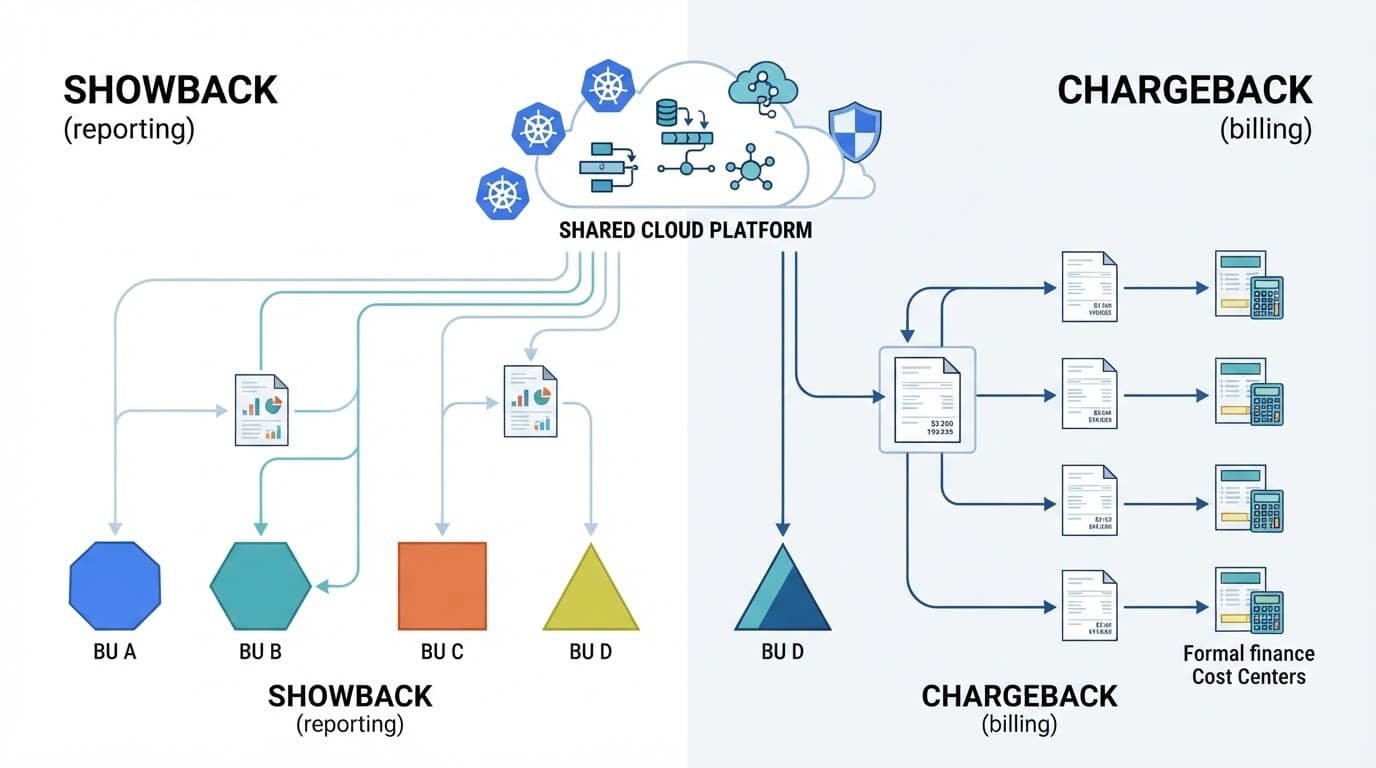
The dividing line is financial formality. IT showback provides cloud cost visibility, while IT chargeback formally transfers charges into a cost center or business-unit budget. That structure maps charges to the cost center hierarchy used by business units.
The FinOps Foundation guidance describes the distinction in similar terms: chargeback sends expenses to official accounting budgets, while showback does not.
| Aspect | Showback | Chargeback |
|---|---|---|
| Financial action | Reports allocated spend | Transfers expense to an internal budget and the general ledger |
| Primary purpose | Visibility and behavior change | Financial accountability |
| Main audience | Engineering and product owners | Engineering, finance, and budget owners |
| Error tolerance | Issues can be corrected in reports | Controls must limit financial disputes |
| Best starting point | New or changing allocation models | Stable, reconciled allocation models |
Showback exposes consumption without moving money
Showback gives each team a monthly view of its attributed cloud spend. A product team might see its namespace compute, storage, network traffic, and share of platform observability costs.
Because no budget changes hands, teams can test whether the report matches operational reality. They can question a sudden increase, identify missing tags, or challenge a cost driver without opening a finance dispute.
Showback also helps platform teams explain costs that are easy to overlook, such as control-plane services, security tooling, central logging, and idle cluster capacity.
Chargeback creates a formal internal bill
Chargeback turns an agreed allocation into an accounting event. Finance may post a journal entry to the general ledger, issue an internal invoice, or charge a cost center through an existing planning system.
Before posting, invoice reconciliation must confirm that source charges match the amount assigned.
That step improves budget ownership. However, it also raises the standard for data quality, reconciliation, documentation, and dispute handling. A chargeback model needs a named owner for every rule, a defined close calendar, and a way to correct prior-period errors in the general ledger.
The same distinction applies to specialized capacity, where GPU chargeback should follow tested reporting before formal billing.
Start with showback before internal billing
A showback period is where cloud cost allocation earns credibility. It gives an IT showback a controlled test against service ownership, capacity plans, and the provider billing export. Engineering managers and finance partners can review the cloud spend before charges affect departmental budgets.
A mature model doesn’t need to allocate every cent at launch. It should test future general ledger postings while stating clearly what remains unallocated, why it remains there, and who will fix it.
An allocation can reconcile to the provider invoice and still fail operationally if it hides untagged spend, idle capacity, or discount treatment.
Define cost objects and ownership rules
Begin with a usable cost center hierarchy. It should connect cloud accounts, subscriptions, projects, namespaces, products, environments, and legal entities where relevant.
Tags and labels should capture stable ownership fields, such as application, business unit, environment, and service owner. Avoid relying on a single “team” tag when platform services support multiple products.
The FinOps Foundation’s shared-cost guidance supports allocating shared spend to the business areas that create it. That principle works only when the policy defines shared cost allocation for common platform overhead, rather than mixing it with direct consumption.
Run a shadow chargeback period
Publish shadow chargeback reports for at least two completed billing cycles before moving money. Give business units a clear review date and a defined path for disputes.
During this period, measure tagging coverage, allocation completeness, and data ingestion timing for the source data. Track late-arriving charges and the difference between allocated cost and the finalized provider bill. Finance should approve the calculation, timing of adjustments, and allocation rules used when disputes involve unsupported drivers.
The same review period can also validate GPU chargeback before accelerator costs affect budgets.
A FinOps chargeback showback program becomes more durable when teams can see their future internal bill before it becomes an unreviewed general ledger entry.
Shared cost allocation without distorting budgets
Shared Kubernetes, data, networking, and security services rarely map cleanly to one owner. A central platform team may run them, but shared cost allocation should reflect product teams’ underlying demand, not platform ownership.
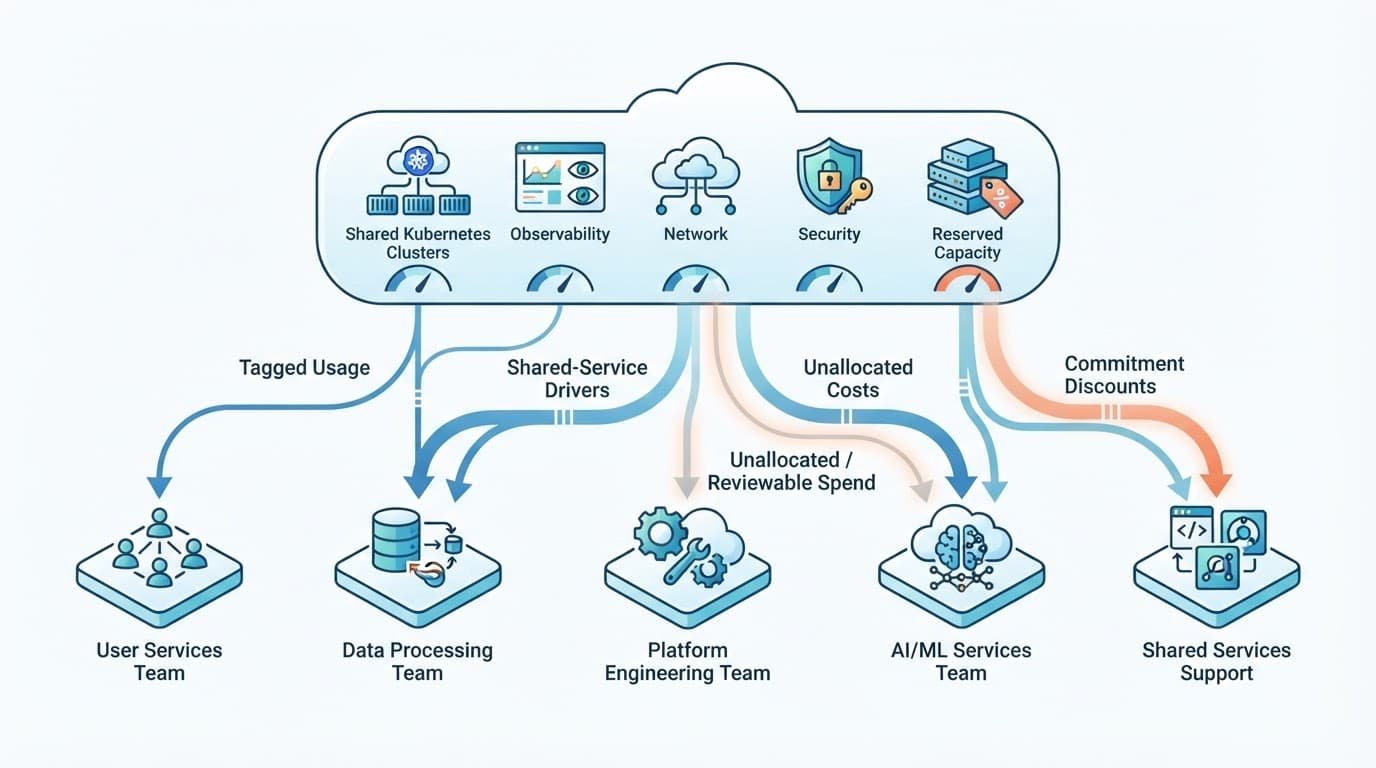
First, allocate directly attributable costs, then apply usage-based drivers to genuinely shared services. This cloud cost allocation sequence keeps central overhead and unallocated spend visible instead of quietly pushing them into product budgets. The FinOps Foundation’s shared-cost guidance also supports tracing each allocation to a financial destination in the general ledger.
Use a driver that matches the service
Choose an allocation driver that a team can understand and audit. It should match the service delivered and support credible unit economics. Kubernetes worker costs may follow requested or consumed vCPU-hours and GiB-hours. Network egress can follow transferred gigabytes. A shared data platform may use query volume, storage, or compute time.
For shared clusters, allocation data needs more than account-level tagging. AWS documents that Amazon EKS split cost allocation can expose pod-level cost data and aggregate it by namespace, cluster, and tags. Other platforms need comparable workload-level attribution before teams can trust cluster charges or support GPU chargeback for partitioned accelerators.
Use proportional allocation only where a direct meter is unavailable. For example, distribute a shared security service by protected workload count or active identities. Use those drivers only when they defensibly reflect underlying cloud spend.
Keep unallocated costs in their own pool
Untagged machines, orphaned disks, or shared gateways with no accepted driver should not disappear into a broad percentage split. Place them in an unallocated cost pool and assign a remediation owner. Report the pool’s monthly trend to support cost optimization.
Clear allocation rules should separate costs into these treatments:
- Directly attributed charges go to the consuming product team or relevant business units. Each output remains traceable to its financial destination in the general ledger.
- Shared variable costs use a documented usage driver.
- Shared fixed costs, including central platform operational overhead, stay with the platform cost center or follow an approved proportional rule.
- Untagged and orphaned spend remains visible until ownership is resolved.
- Commitment fees and unused capacity receive their own treatment.
Separate consumption costs from commitment and invoice views
Provider bills contain more than workload usage. Reserved instances, savings plans, and commitment discounts can all change what finance pays. Enterprise credits, refunds, and support charges can also affect the provider invoice. Finance records that accounting event in the general ledger.
Showback and chargeback should use an amortized or effective-cost view when the goal is to show teams the economics of their consumption. Keep a billed-cost view alongside it for cash forecasting and tracking total cloud spend. The billed view should also support journal-entry treatment in the general ledger.
Handle discounts and unused commitments openly
A workload that received commitment discounts should see the effective cost of that consumption. Yet unused committed capacity shouldn’t be hidden inside the rates of teams that used the platform efficiently.
Some organizations allocate unused commitment cost to a central finance or platform owner. Others distribute it to business units under an approved shared cost allocation policy. Either approach can work when the policy is transparent, consistent, and reviewable. The same principle applies to GPU chargeback, where specialized capacity also needs transparent treatment for discounts and unused commitments.
The key is to preserve the bridge between provider charges, effective consumption cost, discount allocation, unused commitment, and internal outputs. This bridge supports invoice reconciliation against the source invoice and keeps the general ledger aligned with provider charges. Without it, internal bills may look precise while failing to match financial records.
Make invoice reconciliation a joint monthly control
Finance owns payment and accounting treatment, supporting financial accountability. It also manages the IT chargeback posting process and the final internal posting to the general ledger. Platform and FinOps teams validate usage sources, cost methodology, ownership mapping, and data freshness.
Finance and FinOps should make invoice reconciliation a joint monthly control. Finance confirms payment and accounting treatment; platform and FinOps validate usage, ownership, and data freshness before the financial close. The control should confirm that the general ledger reflects reconciled provider charges.
The FOCUS 1.4 update adds Invoice Detail and Billing Period datasets for end-to-end invoice matching. Those records help teams connect usage data, credits, refunds, and chargeback outputs to the source invoice.
Microsoft’s invoicing and chargeback guidance also places provider bill matching before internal billing. That order prevents an internal bill from becoming a second, unreconciled version of the cloud bill.
GPU chargeback and AI cost allocation
GPU chargeback requires more care than standard virtual-machine allocation. A team may consume GPU-hours through a training job, reserve capacity for a model endpoint, or occupy a partitioned accelerator within a shared cluster.
For AI cost allocation, track the measure closest to the service delivered, such as GPU-hours, job runtime, model calls, tokens, or endpoint uptime. These measures support unit economics and cost-to-serve analysis, but don’t capture all cloud spend. Identify related costs, including cluster overhead, high-speed storage, network fabric, and idle reserved capacity.
Publish a GPU chargeback rate card
An internal GPU rate card should state its inputs. It may include effective accelerator cost, a defined share of platform overhead, and a policy for unused capacity. This supports cost optimization by showing how utilization and idle capacity affect the rate.
Start with showback when metering methods are new, so teams can compare reported consumption with scheduler data and workload records. An approved rate-card result can eventually support posting to the general ledger. Formal GPU chargeback should begin only after engineering and finance accept the rate card, data source, and review process.
A controlled path to chargeback
Chargeback is an operating control within cloud cost management, not a dashboard setting. The following sequence reduces avoidable conflict and creates an audit trail:
- Define the cost center hierarchy for business units and multi-cloud environments. Document cloud cost allocation, shared-cost categories, required metadata, allocation rules, data sources, rule owners, and effective dates.
- Build a billing export pipeline that retains raw charges, effective cost, credits, refunds, invoice identifiers, and account mappings for the general ledger. Assign its owner and document the correction path.
- Publish IT showback reports, record disputes, and have platform owners correct metadata gaps or unsupported allocation methods.
- Complete invoice reconciliation for the finalized provider invoice. Approve internal allocations with clear financial accountability, then post IT chargeback entries through finance controls and the general ledger.
- Review rates, allocation rules, and unallocated cloud spend on a regular schedule. Include GPU chargeback rates in this review, with finance and platform owners approving changes.
Document every rule in plain language, including the data source, allocation method, rule owner, effective date, approval point, correction process, and general ledger account mapping. Before internal posting, the finance owner performs recurring invoice reconciliation, confirms the approval point, and checks the general ledger mapping. Version changes according to the financial close calendar, and record prior-period corrections in the general ledger.
Frequently Asked Questions
What is the difference between FinOps showback and chargeback?
Showback reports allocated cloud spend to teams without changing their budgets. Chargeback formally transfers the expense to a cost center or business-unit budget and may create a general ledger entry.
Why should organizations start with showback?
Showback gives teams time to validate ownership, usage data, shared-cost drivers, and discount treatment before money moves. It also creates a defined period for resolving disputes and correcting allocation problems.
How should shared cloud costs be allocated?
Use direct attribution where ownership is clear and a documented usage-based driver for genuinely shared services. Costs without a defensible driver should remain in an unallocated pool with an assigned remediation owner.
How do commitments and discounts affect chargeback?
Showback and chargeback should distinguish effective or amortized consumption cost from the billed provider cost. Discount allocation, unused commitments, credits, and refunds need transparent policies that preserve reconciliation to the source invoice.
What does GPU chargeback require?
GPU chargeback should use measures that match the service delivered, such as GPU-hours, job runtime, model calls, tokens, or endpoint uptime. Organizations should validate scheduler and workload data through showback before approving a GPU rate card for formal billing.
Conclusion
Shared cloud platforms need cost allocation people can verify and challenge, not an arbitrary split that only balances a spreadsheet. Showback makes cloud spend visible and builds the trust required for meaningful ownership.
Chargeback belongs after the organization can reconcile invoices, explain shared services, account for commitments, and resolve exceptions consistently. Formal charges should reach the general ledger only then. Internal billing can support better unit economics and cost optimization without turning platform costs into a monthly argument.

