A shared cluster can lower platform costs, but a weak tenant boundary can turn one customer incident into a wider security and compliance problem. Kubernetes multi-tenancy is therefore an architecture decision, not a namespace naming convention.
Regulated SaaS teams must balance tenant isolation, auditability, operational speed, residency obligations, and capacity efficiency. The right model depends on what tenants can control, what data they process, and how much shared infrastructure your risk posture permits.
Start with platform engineering decisions that define the boundaries that matter before choosing Kubernetes primitives.
Key takeaways
- Namespaces, RBAC, network policies, Pod Security, resource quotas, and limit ranges form a solid soft multi-tenancy baseline, but they don’t fully prevent a noisy neighbor or create a complete container isolation boundary.
- Virtual clusters give tenants a virtual control plane without requiring a physical cluster for every customer, but the control plane may still share worker nodes.
- Dedicated clusters or nodes are appropriate for hard multi-tenancy when tenant risk, residency commitments, privileged workloads, or contractual terms demand a stronger hard security boundary.
- GPU workloads need special scrutiny because GPU partitioning and compute scheduling alone don’t address accelerator memory, device access, or network paths.
- Compliance evidence must cover identity changes, policy decisions, workload activity, recovery tests, and offboarding, not only Kubernetes configuration.
Why Kubernetes multi-tenancy is difficult
Kubernetes multi-tenancy uses strong building blocks, yet cluster multi-tenancy has no native “tenant” object that automatically joins identity, networking, compute, storage, audit data, and lifecycle controls. The Kubernetes multi-tenancy guidance frames shared clusters as a cost and management choice, but the platform team still has to define each isolation layer.
Internal teams and SaaS customers have different threat models
Multi-team tenancy usually assumes employees operate under one company’s identity, policies, and incident process. A development team may need namespace access without receiving cluster-wide permissions.
Multi-customer SaaS tenancy is stricter. Customers may have competing interests, different retention expectations, and administrators outside your organization. RBAC can limit customer permissions, but access through the Kubernetes API and visibility into cluster-wide metadata require separate review. Any capability that exposes shared secrets, node access, or another tenant’s service traffic needs careful review.
Boundaries extend beyond namespaces
Namespaces scope many Kubernetes objects, but they don’t provide container isolation for the host kernel, node-level agents, storage backends, or the shared API server. Cluster-scoped resources, custom resource definitions, admission controllers, and observability systems can also cross a tenant boundary.
Treat the control plane, including etcd, the data plane, container registry, backup system, identity provider, observability stack, SIEM pipeline, and privileged support paths as part of the same tenancy design. Technical separation alone isn’t compliance evidence, so document access, retention, recovery, and administrative controls. Otherwise, a carefully isolated workload can still leak data through logs, snapshots, metrics, or privileged support access.
Choose a Kubernetes multi-tenancy model by risk
Kubernetes multi-tenancy should match tenant isolation requirements, not follow a single pattern. A cluster multi-tenancy strategy can assign models by customer risk, data classification, autonomy, and workload type.
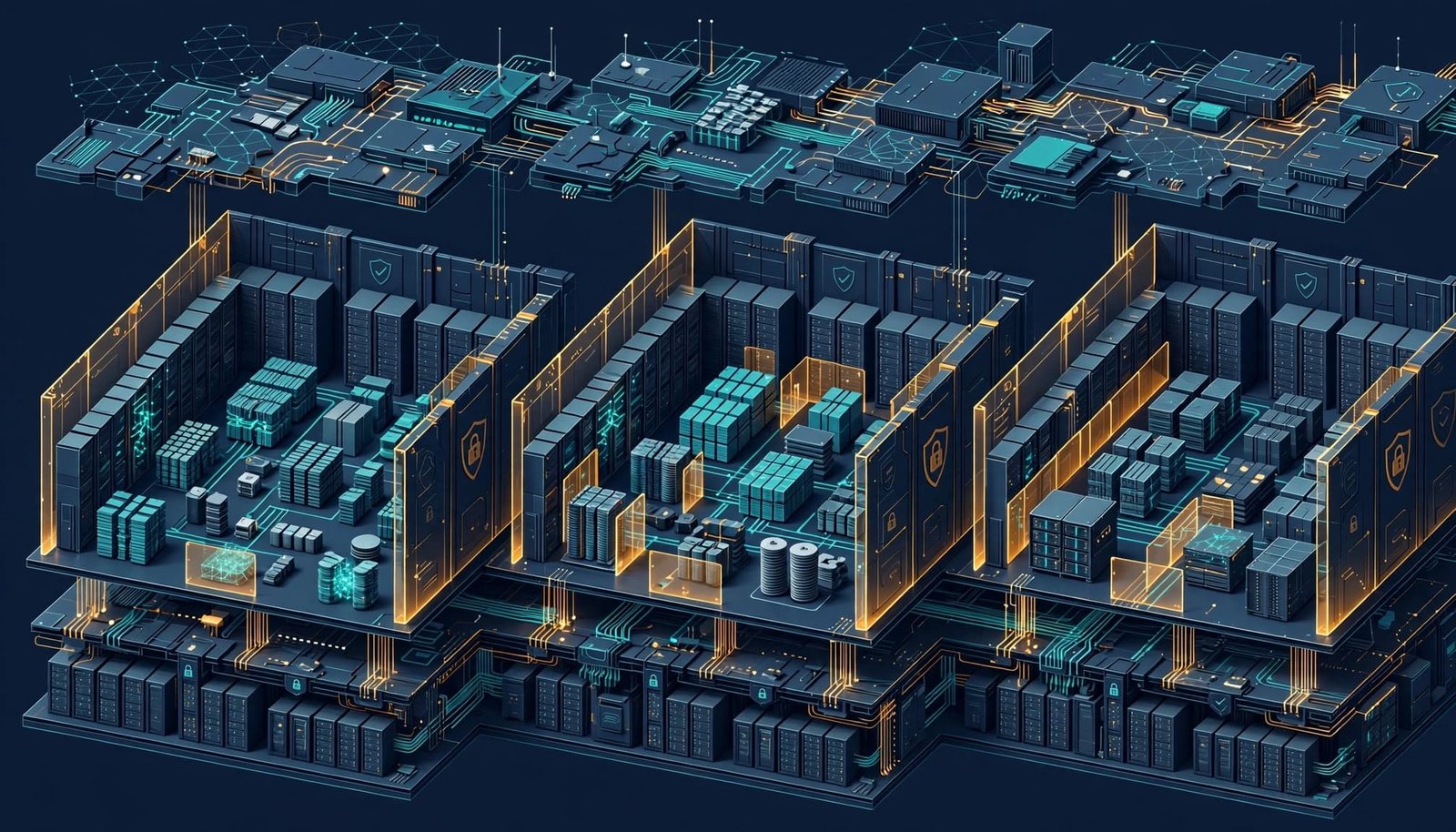
| Model | Primary isolation boundary | Isolation strength | Compliance evidence | Operational complexity | Relative cost | Scalability and density | Upgrade strategy | Data-residency handling | Representative use cases |
|---|---|---|---|---|---|---|---|---|---|
| Namespace tenancy | Namespaces, policies, and shared cluster management | Foundational | Policy, access, and audit records | Low | Lowest | Highest density | Centralized platform upgrades | Shared region or segmented storage | Trusted teams and lower-risk SaaS |
| Virtual-cluster tenancy | Tenant-facing virtual control plane | Stronger logical separation | Tenant-level API and access evidence | Medium to high | Moderate | High density | Coordinate host and tenant upgrades | Assign host locations by region | Customers needing Kubernetes-like autonomy |
| Node-pool tenancy | Node isolation, scheduling, and network isolation | Strong workload separation | Placement, scheduling, and node evidence | Medium | Moderate to high | Good density with reduced packing | Upgrade pools independently | Place pools in approved zones | Sensitive workloads with hardware or kernel needs |
| Dedicated-cluster tenancy | Separate cluster administration and data plane | Strongest standard boundary | Clear per-tenant cluster evidence | High | Highest | Lowest density | Upgrade each cluster independently | Use dedicated regions or provider boundaries | High-risk tenants and strict contractual isolation |
Use namespaces for controlled shared tenancy
Namespace tenancy is a form of soft multi-tenancy that works well when your platform team owns deployment pipelines. Tenants typically don’t need broad Kubernetes API access. Each tenant receives scoped service accounts, quotas, network policies, and observability views, with RBAC limiting administrative reach.
This model is efficient, but it relies on disciplined configuration. A tenant should not create privileged Pods, bind broad ClusterRoles, bypass admission policy, or access shared credentials. Treat it as an application and platform boundary, not an absolute infrastructure boundary.
Add virtual clusters when tenants need autonomy
Virtual clusters, including vCluster, give each tenant a tenant-facing Kubernetes API and virtual control plane experience while workloads run on a host cluster. That separation can reduce conflicts around RBAC objects, namespaces, and tenant-specific APIs. Operational planning may also need API priority and fairness for busy shared environments.
However, virtual clusters still depend on the host cluster’s nodes, networking, storage, and platform operators. The vCluster isolation considerations are useful when assessing those shared dependencies. A virtual control plane improves separation, but it doesn’t replace host hardening or eliminate shared infrastructure risk.
Reserve dedicated infrastructure for high-consequence workloads
Node-pool tenancy improves node isolation and scheduling, but it still shares the host cluster’s management systems. Use additional network isolation when sensitive workloads require distinct traffic paths. Virtual machines can add another workload or host boundary where the risk justifies it.
Dedicated clusters provide stronger separation than node pools and simplify per-tenant evidence collection. Account, subscription, or project boundaries also vary across cloud service providers, so confirm how each provider handles identity, logging, and residency.
For some customers, a dedicated physical host or bare metal environment may be necessary. Those choices cost more, yet they can reduce the number of compensating controls and exceptions your team must defend during an audit.
Build the shared-cluster security baseline
Soft multi-tenancy works only when every namespace begins with restrictive defaults. Platform engineering should apply those controls through GitOps, admission policies, and automated tenant provisioning. This baseline supports a shared control plane, but it isn’t a complete hard boundary.
Scope RBAC to the smallest practical permission set
Use namespace-scoped Roles and RoleBindings for routine tenant access. A ClusterRole can support a namespace RoleBinding, which reuses narrowly defined permissions without granting cluster-wide access. Namespaces should also limit access to shared metadata and administrative resources.
RBAC permissions are additive, and Kubernetes RBAC has no deny rule. Review group membership, service-account tokens, impersonation permissions, and access to the Kubernetes API with the same care as production credentials. Avoid granting cluster-admin to solve deployment friction.
Default-deny network traffic and constrain Pods
Apply default-deny ingress and egress network policies, then allow only known service paths, DNS access, approved external endpoints, and required observability traffic. Verify that your CNI enforces those network policies and permits only the paths you expect.
Pod Security Admission should enforce the appropriate Pod Security Standard. The baseline and restricted profiles limit risky settings, while enforce, audit, and warn modes support staged adoption. Pair Pod Security with image provenance, runtime detection, and controls over host mounts, capabilities, host networking, and privileged workloads. These controls strengthen container isolation without proving that every runtime threat is contained.
Also define workload identity, encryption in transit and at rest, audit logging, and admission policies. Together with image provenance and runtime security, these technical controls support a compliance program, but they aren’t proof of compliance by themselves.
Stop a noisy neighbor before it creates incidents
Resource quotas limit aggregate namespace consumption, including compute resources, ephemeral storage, GPUs where relevant, and selected object counts. Limit ranges set per-object minimums, maximums, and defaults. Together, they prevent a tenant from consuming unbounded CPU, memory, storage, or Kubernetes objects.
Set resource quotas from observed workload behavior and scheduler requirements. Include storage objects such as a persistent volume claim, along with GPU reservations where applicable. A quota that’s too low creates deployment failures, while one that’s too generous weakens capacity protection.
Chargeback also works better when ownership labels and requested capacity map to a documented allocation policy. Kubernetes cost allocation with OpenCost can help make those shared costs traceable.
Isolate GPUs and networks for sensitive AI workloads
AI workloads can change the tenancy decision because GPU partitioning and high-throughput networks introduce resource paths that ordinary namespace controls don’t address.

Use hardware-backed GPU partitioning where supported
NVIDIA Multi-Instance GPU (MIG) provides GPU partitioning for supported hardware, with isolated instances and dedicated compute and memory resources. That improves scheduling predictability and reduces contention compared with unrestricted sharing of a full GPU.
MIG isn’t a complete compliance boundary. Accelerator partitioning doesn’t replace container isolation, identity controls, workload policy, node access, storage handling, telemetry restrictions, or operator privilege controls. Sensitive data may also require dedicated GPU nodes or a dedicated cluster, even with GPU partitioning. That provides stronger node isolation and clearer reset and allocation procedures.
Treat DPU-based segmentation as an infrastructure control
Data Processing Units can enforce parts of networking and security policy in the data plane outside the host CPU, particularly in bare metal designs. Their value depends on the hardware, operating model, network fabric integration, and failure behavior.
Use DPUs when they provide a verified enforcement point for network isolation, not as a substitute for Kubernetes network policies or workload identity. Document allowed paths, packet inspection scope, key management responsibilities, reset behavior, and telemetry coverage. Incident responders need that map and its supporting evidence before an outage or suspected cross-tenant event occurs.
Operate for evidence, recovery, and residency
A tenancy architecture is credible only when it produces evidence and survives failure. Security reviews often expose operational gaps rather than a missing Kubernetes feature.
Collect tenant-aware evidence without collecting excess data
Capture Kubernetes API activity, changes to RBAC and network policies, deployment events, workload security findings, and privileged support actions. Record control plane admission and identity changes, along with data plane workload activity, service traffic, storage events, and runtime findings. Route these records to a central system with retention, access controls, and time synchronization that match your obligations.
Logs need tenant identifiers that remain useful after namespaces are deleted. At the same time, redact secrets, tokens, and sensitive payloads before export. The DORA compliance checklist for IT teams offers a useful lens for mapping service dependencies, incident handling, and third-party responsibilities.
Plan residency, disaster recovery, and offboarding together
A namespace does not establish data residency. Compare cloud service providers by region, account boundaries, provider-managed services, and support or logging locations. Confirm the residency of persistent volumes, snapshots, backups, container registries, log archives, message queues, SIEM exports, support exports, encryption keys, and disaster-recovery replicas. Qualified legal counsel should interpret contractual and regulatory residency requirements for each market.
Test restores with tenant-scoped data and measure the recovery objectives your contracts promise. Map administrative and recovery dependencies across the control plane, including etcd backups, without treating direct access as a tenant control. During offboarding, document per-tenant evidence, incident containment, key deletion or rotation, identity removal, backup expiry, and verifiable data deletion. A cloud exit strategy planning guide helps expose hidden control-plane and identity dependencies before they become an exit risk.
A concise decision checklist
Use this Kubernetes multi-tenancy checklist with security, SRE, product, platform, and legal stakeholders:
- Which model fits each tenant: namespaces, virtual clusters, node-pool tenancy, or dedicated clusters, and which layer remains shared?
- Can tenants deploy arbitrary workloads, install operators, or access the Kubernetes API directly, or do network policies, RBAC, and Pod Security limit them?
- What can tenants administer in namespaces, a virtual control plane, and what remains platform-operated in the control plane?
- Will resource quotas and limit ranges prevent a noisy neighbor from exhausting CPU, memory, ephemeral storage, GPU capacity, or network bandwidth?
- Does sensitive AI data require dedicated compute or GPU partitioning rather than shared worker capacity?
- Are shared workers, storage backends, and traffic in the data plane acceptable, or are network isolation, node isolation, bare metal, or virtual machines required?
- Does the architecture keep primary data, backups, and logs within required locations across cloud service providers?
- Should cluster multi-tenancy use tiers or a hybrid model, with stronger boundaries for higher-risk tenants?
- Can platform engineering produce per-tenant evidence for upgrades, access changes, incident investigation, disaster recovery, restore tests, data deletion, and offboarding?
- Can the platform isolate, investigate, restore, and offboard one tenant without exposing another?
Frequently asked questions
What is the difference between soft and hard multi-tenancy?
Kubernetes multi-tenancy can use soft multi-tenancy, sharing a cluster while separating tenants with namespaces, RBAC, network policies, Pod Security, and resource limits. This is cost-efficient when platform operators retain strong workload control.
Hard multi-tenancy adds stronger boundaries, such as a virtual control plane, dedicated nodes, a dedicated cluster, a separate account or project, or physical infrastructure. It reduces shared attack surface, but increases operating cost and platform complexity.
Are virtual clusters enough for regulated SaaS?
Virtual clusters can improve tenant-facing Kubernetes API access by providing a virtual control plane. The shared control plane may still manage underlying resources, so this model sits between namespaces and dedicated clusters.
Their suitability depends on the remaining shared layers. With virtual clusters, a virtual control plane may improve tenant-facing separation, but host nodes, the data plane, networking, storage, observability, operators, backups, and privileged administration may remain shared. Review control plane administration, etcd state, backup handling, and network isolation according to the implementation. Regulated workloads may require dedicated infrastructure when those shared layers cannot meet contractual or risk requirements.
Build boundaries that match the tenant risk
The safest model matches the workload’s real exposure, not the cheapest model that passes review. Kubernetes multi-tenancy works best as a tiered design, with stronger boundaries for tenants that need them.
Start with restrictive shared-cluster defaults and namespaces for lower-risk workloads. Give higher-autonomy tenants virtual clusters with a separate control plane. Use node pools and network isolation when sensitive workloads need a stronger data plane boundary.
A hybrid platform can reserve dedicated clusters for sensitive data, privileged workloads, residency commitments, or high-consequence incidents. Kubernetes multi-tenancy should also account for upgrade coordination, evidence collection, incident response, disaster recovery, and offboarding. Align regional deployment with cloud service providers and their account or project boundaries, since the least expensive model isn’t always suitable, and the strongest isn’t always operationally optimal.

