The water story around AI datacenters gets distorted by averages. A site can look efficient on paper and still strain a local system on the hottest week of the year.
For planners, datacenter water use now sits beside power, land, and fiber as a hard design constraint. In 2026, the useful question is not “How much water?” It is “Which water metric, at which time, in which place?”
Start with the right water math
Most water debates collapse several different numbers into one. That is where bad planning starts.
First, separate water withdrawal from water consumption. Withdrawal is the volume pulled from a utility, well, or other source. Consumption is the share that does not return to the same basin, often because it evaporates in cooling towers. A campus can withdraw a lot and consume less, or consume heavily with modest average withdrawal if evaporation is the main path.
Next, split onsite from offsite water use. Onsite water covers cooling towers, humidification, and other facility loads. Offsite water sits in the power supply chain, especially thermal generation. Current reporting and research suggest that, for AI-heavy loads, offsite water can dominate the total footprint. That is one reason Brookings’ analysis of AI, data centers, and water pushes regional coordination, not only site accounting.
Then, separate peak impacts from annualized impacts. Annual WUE can help compare facilities, but utilities and neighbors feel the stress during hot, dry peak periods. A summer afternoon can matter more than a respectable yearly average.
Annual WUE is useful, but it does not capture offsite water or peak-day system stress.
That gap matters more for AI clusters because they hold high utilization for long periods. Public disclosure is still incomplete in 2026, especially at the site level, so planners should treat corporate averages as a starting point, not a permitting answer. For background on where AI water accounting often gets oversimplified, IEEE Spectrum’s reporting on AI water usage is a helpful reference.
Cooling design changes water use more than labels suggest
A label like “liquid-cooled AI cluster” does not tell you the full water story. The heat rejection path still decides much of the outcome.
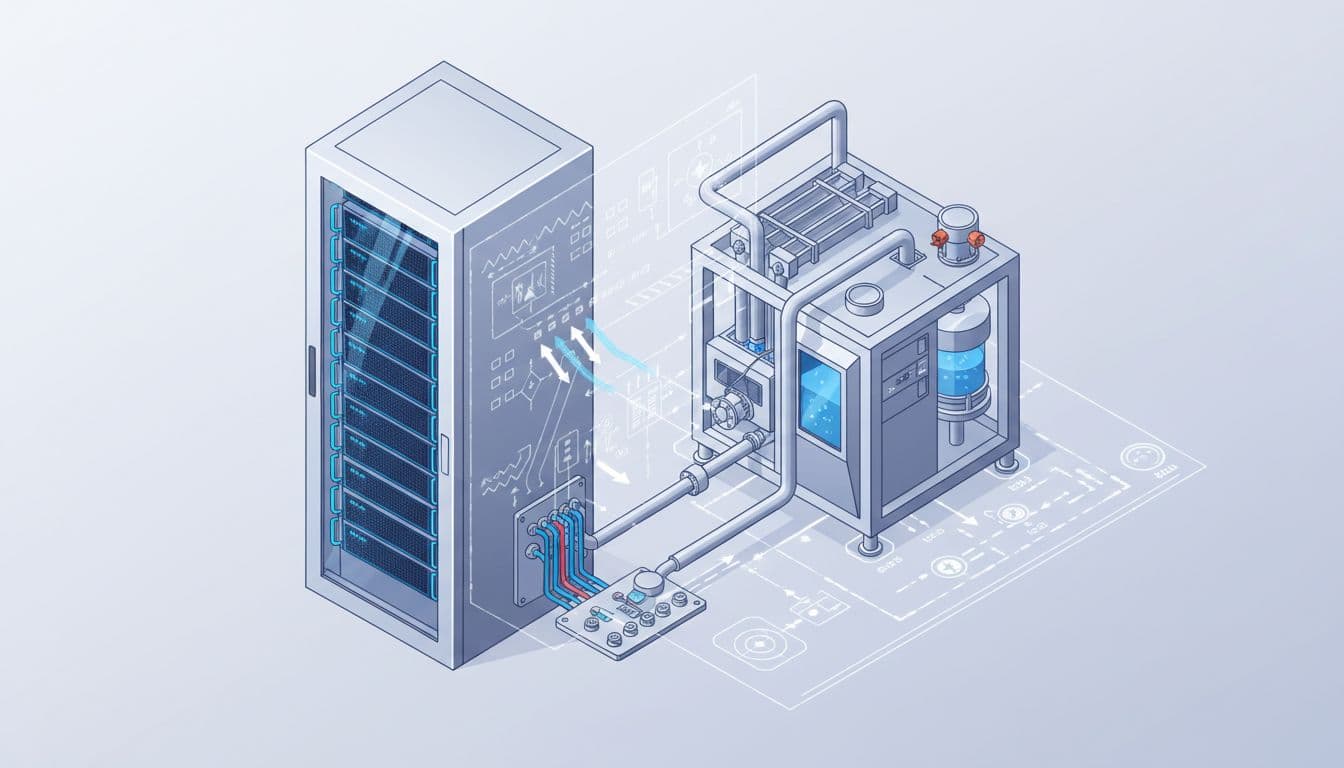
Direct-to-chip cooling cuts server fan energy and handles dense GPU racks well. Yet if that loop rejects heat through evaporative towers, site water consumption may stay high. By contrast, dry coolers or fully air-cooled chillers can cut water sharply, but they usually raise power draw and may reduce thermal headroom during heat waves.
This comparison helps frame the tradeoff:
| Cooling approach | Water profile | AI thermal fit | Cost tradeoff | Location fit |
|---|---|---|---|---|
| Evaporative air or tower-based chilled water | High onsite consumption, lower cooling power | Good for large loads | Lower operating power, moderate capex | Better where water is reliable |
| Dry air cooling | Near-zero onsite water | Limited as densities climb | Higher cooling energy, simpler water systems | Better where water is scarce |
| Direct-to-chip with dry cooler or hybrid mode | Low to medium water, depends on heat rejection mode | Strong for dense GPU racks | Higher capex, lower fan energy | Good when heat and water both matter |
| Immersion cooling | Low onsite water potential, but system design matters | Strong for extreme density | Higher process change and service cost | Best for specialized builds |
The main takeaway is simple. Chip cooling and facility cooling are different decisions. A direct-to-chip loop can improve rack density and PUE, while the site still burns water through towers. On the other hand, a dry design may protect basin risk while adding power cost on hot days.
That is why many new plans use hybrid control logic, reclaimed water, or seasonal operating modes. Data Center Frontier’s coverage of reclaimed water and reuse systems shows how operators are trying to balance efficiency with local trust.
Site risk in 2026 is about timing and place
The broad numbers are large. North American datacenters used nearly 1 trillion liters of water in 2025, based on current reporting summarized in recent coverage. Yet the sharper planning issue is where and when that demand lands.
A March 2026 study, covered in The Register’s summary of peak water demand, warned that hot-day spikes could strain U.S. water systems even when annual totals look manageable. That point matters for AI campuses because high-density clusters keep cooling systems loaded for long periods. In dry regions, the design-day case often determines community response, utility upgrades, and permit risk.
Public company data also remains uneven. Meta reported 5,637 megaliters of water use in 2024 for owned sites, up from 3,726 megaliters in 2020. Other large operators disclose less site-level detail, or frame water relative to energy rather than local basin impact. For planners, that means you cannot outsource due diligence to sustainability reports.
Use a short screen before locking site and cooling choices:
- Model hourly withdrawal and consumption for design-day weather, not only annual WUE.
- Separate potable, reclaimed, and backup water sources in the basis of design.
- Include offsite water from the expected electricity mix during peak dispatch hours.
- Test maintenance, failover, and heat-wave modes, because those often drive worst-case water draw.
- Review basin stress, competing users, and utility expansion timing before signing land.
Some emerging ideas look promising. For example, the European Commission highlighted research on using datacenter waste heat for water purification. Still, planners should treat those projects as future options, not base-case mitigation.
The planning takeaway
Averages still matter, but local timing decides whether a project is buildable. The most useful water plan separates withdrawal from consumption, onsite from offsite, and peak demand from annual totals.
For AI cluster planning, the best answer is usually not the most efficient cooling system in isolation. It is the system that fits the basin, the utility, the weather profile, and the rack density at the same time.

