Picking a managed Kubernetes service by sticker price is a good way to miss the real bill. In 2026, EKS, AKS, and GKE pricing still starts with the control plane, but most platform teams spend far more on nodes, traffic, storage, and observability.
That matters because the cheapest-looking option on day one can become the most expensive at scale. The details below focus on list pricing, typical usage costs, and the add-ons that usually decide where your budget goes.
Start with the list price, then move past it
The control plane is the visible fee, so it’s where most comparisons begin. It’s also where many of them stop too early.
In 2026, Amazon EKS charges about $0.10 per hour per cluster under standard support, or roughly $72 to $74 per month. If you stay on an older Kubernetes version and fall into extended support, that jumps to $0.60 per hour, or about $438 per month. EKS also has an optional provisioned control plane for very large scale, but most teams won’t need it.
Google Kubernetes Engine also charges $0.10 per hour per cluster, about $74.40 per month, for Standard and Autopilot clusters. The big exception is GKE’s free credit for one zonal cluster per billing account. That wipes out the management fee for a small non-regional cluster, but it doesn’t apply to regional or multi-zonal designs.
AKS is where 2026 comparisons get messy. Many summaries still say “AKS has a free control plane,” and that can be true for the Free tier. But production teams often choose Standard, which is about $0.10 per hour, or Premium, which is much higher and mainly buys longer version support.
The basic comparison looks like this:
| Service | 2026 cluster management list price | What changes the number |
|---|---|---|
| EKS | $0.10/hr standard, $0.60/hr extended | Version age, optional provisioned control plane |
| AKS | Free tier, Standard about $0.10/hr, Premium much higher | SLA needs, support tier, cluster purpose |
| GKE | $0.10/hr, with one zonal cluster credit | Zonal vs regional design, billing account credit |
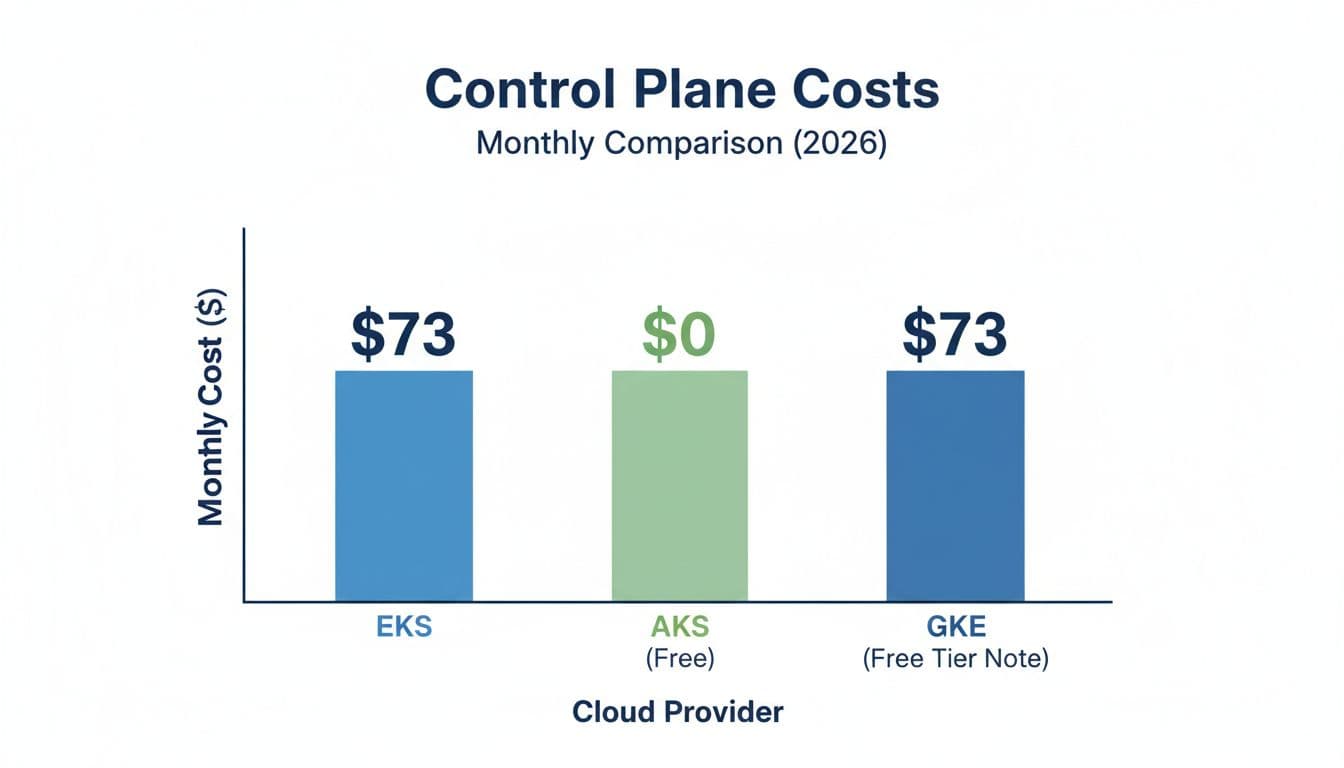
A few dollars per day doesn’t sound like much, until you run a fleet. Ten small EKS clusters cost about $730 per month in control plane fees alone. Ten GKE clusters can drop slightly if one qualifies for the zonal credit. AKS may cost little or nothing at the control plane layer if Free fits the use case, but that is often a dev or light-use story, not a production default.
For a useful side-by-side reference, CloudToolStack’s Kubernetes comparison and Reintech’s 2026 managed Kubernetes comparison both show the same pattern: control plane pricing matters most when you run lots of clusters or small environments.
If you run many small clusters, management fees stop being background noise.
Compute still dominates the bill
Once workloads hit production, nodes decide most of the spend. That is why EKS vs AKS vs GKE pricing rarely has a single winner across real teams.
On EKS, worker nodes are standard EC2 instances. A small t3.medium is about $30 per month. Three m5.large nodes land near $207 per month. Four m5.xlarge nodes reach about $561 per month. Spot instances can cut that sharply, in some cases by as much as 70%, but they add interruption risk and scheduling work.
AKS follows the same pattern with Azure VMs. In East US, a Standard_DS2_v2 is about $0.096 per hour, close to $70 per month. A Standard_F4s_v2 is about $0.169 per hour, while a memory-heavy Standard_E4s_v3 is about $0.252 per hour. Azure Spot VMs and Reserved Instances can move the total a lot, especially for steady production pools.
GKE Standard uses Compute Engine VM pricing. An e2-medium example is around $24 per month. That looks cheap, but don’t compare it directly to a DS2_v2 or m5.large without matching CPU and memory. Equivalent node shapes matter more than the provider label. GKE also benefits from autoscaling and committed-use discounts, so a well-packed cluster often costs less than its raw list price suggests.
This is why most serious cost work starts with workload shape, not vendor marketing. A platform team that keeps node utilization high, rightsizes requests, and separates steady services from bursty jobs can save more than the control plane fee difference.
A recent 2026 pricing comparison from Spendark makes the same point. The control plane is usually under 10% of a production cluster’s total. Compute, storage, and network carry the rest.
For most production clusters, node spend and traffic matter more than the management fee.
Autopilot and Fargate can help, but only for the right workloads
Serverless-style Kubernetes options change the math because you stop paying for whole nodes and start paying closer to pod demand. That sounds cheaper, but only when your workload profile fits.
On GKE, Autopilot still carries the standard cluster fee after any free credit, but it bills workloads by requested CPU, memory, and ephemeral storage. For spiky internal platforms, dev environments, or teams that hate managing node pools, that can be a strong trade. Half-empty nodes disappear from the bill. On the other hand, if your pods run all day with stable demand, Standard mode on well-packed nodes can cost less.
EKS Fargate works in a similar direction. The 2026 list price is about $0.0405 per vCPU-hour plus $0.004445 per GB-hour. A small cluster’s worth of Fargate-backed services can land around $250 to $300 per month, sometimes more, depending on requests and run time. The convenience is real, but over-requested pods get expensive fast because you pay for what you ask the scheduler to reserve.
AKS doesn’t have a neat one-line equivalent in the pricing data above, so most AKS models still start with VM node pools, autoscaling, and good pool design. That makes AKS cost control more about sizing and placement than about per-pod billing tricks.
The key point is simple. Automation reduces wasted operator time. It doesn’t always reduce wasted compute. If requests are bloated, both Autopilot and Fargate turn that waste into a clean, itemized bill.
If you want a rough sandbox for estimates, Project Helena’s Kubernetes cost calculator is useful for testing broad cluster shapes before you build a full provider-native model.
Hidden costs are where estimates break
A managed Kubernetes bill rarely fails because of the control plane. It fails because the “small” extras grow at the same speed as the platform.
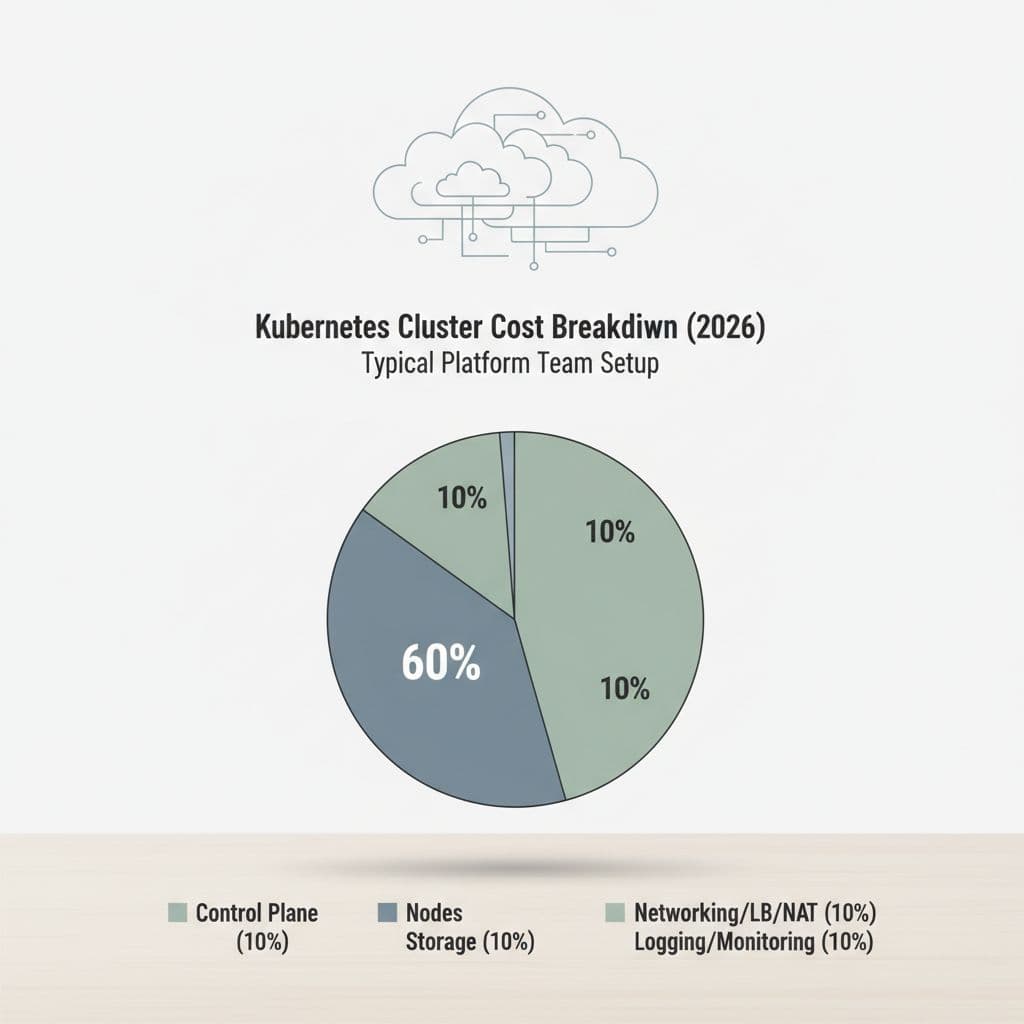
On EKS, storage is often modest at first. gp3 EBS runs around $0.08 per GB per month, so 300 GB is only about $24. Then networking shows up. Two NAT gateways with moderate traffic can cost about $75 per month, and fleets with many load balancers can climb quickly. One 2026 estimate put 20 NLBs at $700 to $900 per month. Observability gets even harder to predict. CloudWatch log ingestion around $0.50 per GB and processing near $0.25 per GB can push a 2 TB month close to $972.
AKS has the same pattern, even if the line items look cleaner. Azure Managed Disks are about $0.12 per GB per month in the example data. A Standard Load Balancer is around $0.025 per hour, or roughly $18 per month. Logging and monitoring need extra care because pricing depends on Azure Monitor workspace choices, retention, and ingestion. You should model those separately instead of assuming they’re noise.
GKE is similar. Persistent disks run roughly $0.04 to $0.17 per GB per month, depending on type and region. Load balancers are about $0.025 per hour plus data processing fees. Cloud Logging can range from $0.50 to $2.50 per GB ingested, and Cloud Monitoring charges on metric volume after free allowances. If you add Backup for GKE, management is about $9 per namespace per month plus storage charges.
Cross-zone traffic is another common miss. Platform teams often spread nodes across zones for availability, then forget that east-west traffic can carry a price. The exact charge depends on cloud, region, and network path, but the cost driver is always the same: chatty services across zones create a second bill after compute.
Support and version policy also matter. EKS extended support is the clearest example because the fee jumps six-fold on older versions. AKS Premium adds cost for longer support windows. GKE’s free credit helps only in limited cluster layouts, so regional production designs won’t get the same break.
SFEIR’s comparison of real cluster costs makes the broader point well: hidden costs can consume a large share of the budget, often far more than teams expect in early planning.
Logs, metrics, cross-zone traffic, and version support can turn a “cheap” cluster into an expensive platform.
A few realistic cost models for 2026
The fastest way to compare EKS, AKS, and GKE pricing is to stop asking for one winner and start testing your actual operating model.
The table below uses list prices and simple US-region examples. These are illustrative, not provider quotes, and they exclude taxes and enterprise discounts.
| Scenario | EKS | AKS | GKE | What usually decides it |
|---|---|---|---|---|
| 10 small dev/test clusters | About $730/month in standard cluster fees before nodes | Free tier can be low-cost for non-production, Standard is similar to EKS | About $670 after one zonal free credit, before nodes | Fleet size and whether free tiers apply |
| 1 small production cluster, 3 general-purpose nodes | Often lands around $350 to $600 with nodes, storage, NAT, LB, logs | Often in the same band, lower if Free fits, higher if Standard or Premium is required | Often in the same band, with free credit helping only on eligible zonal clusters | Node shape, private networking, observability |
| Mid-scale platform, 5 clusters and 50 nodes | Usually compute and network-led, not control-plane-led | Same pattern, with VM family and Monitor choices doing most of the work | One published 2026 example lands near $7,345/month | Commitment discounts and workload density |
A few patterns stand out.
First, many-cluster platform models punish EKS and GKE faster because the control plane charge repeats across every environment. AKS can look better for dev fleets if Free tier fits.
Second, steady production services often pull the three providers into a similar cost band once you compare equivalent node families. In that case, the big swings come from committed spend, rightsizing, and network design.
Third, burst-heavy internal platforms can flip the result. GKE Autopilot or EKS Fargate may beat underfilled node pools, but only if your pod requests are disciplined.
Your existing commitments can outweigh price-sheet differences
Platform teams don’t buy Kubernetes in a vacuum. They buy it inside IAM, network policy, support contracts, finance rules, and cloud discounts that already exist.
If your AWS estate already leans on Savings Plans, mature VPC patterns, and EC2 Spot discipline, EKS can be cheaper in practice than its list price suggests. The same logic applies on Azure with Reserved Instances and on Google Cloud with committed-use discounts. A control plane delta of $70 per month is easy to erase when you’re already getting a large break on compute.
Operational fit matters too. EKS often wins when the rest of the platform is already AWS-native. AKS usually gets an edge in Microsoft-heavy shops that want tighter alignment with Azure networking, identity, and management patterns. GKE often appeals to teams that want a polished Kubernetes experience and, in some cases, easier per-pod economics through Autopilot.
That means the right question isn’t “Which cloud is cheapest?” The better question is “Which service gives us the lowest total cost for this workload mix, with our current commitments and team skills?”
For a broader comparative view that includes operational tradeoffs, this 2026 EKS, GKE, and AKS comparison is a helpful companion to direct pricing work.
A concise recommendation matrix for platform teams
This matrix is short on purpose. Most teams need a working default, not a philosophical answer.
| Common situation | Likely cost fit | Why | Watch for |
|---|---|---|---|
| Lots of small dev or preview clusters | AKS Free tier or GKE with one eligible zonal cluster | Lower or waived management fee helps small environments | Free-tier limits, missing SLA, regional layouts |
| Dense, steady 24/7 production | Any of the three | Compute efficiency and discounts matter more than cluster fee | Wrong node family, overprovisioned headroom |
| Spiky internal services, frequent scale-up and scale-down | GKE Autopilot, then EKS Fargate | Per-pod style billing can beat half-empty nodes | Inflated resource requests |
| AWS-first platform with strong EC2 discounting | EKS | Existing commitments can erase price-sheet gaps | NAT, load balancers, CloudWatch growth |
| Microsoft-heavy enterprise platform | AKS | VM pricing is familiar, and platform fit can reduce ops cost | Monitor and Premium tier add-ons |
| Teams that want fewer node-pool decisions | GKE Autopilot | Simpler operations can justify premium unit pricing | Long-running steady workloads may cost more |
A common mistake is to treat this as a beauty contest between control planes. It isn’t. Platform teams should compare three layers at the same time: management fee, compute pattern, and hidden services. Miss any one of those, and the forecast will drift.
Conclusion
The real story in 2026 is simple. EKS, AKS, and GKE pricing starts with a small management fee, then turns into a workload and operations problem.
For small fleets, control plane charges can matter a lot. For production platforms, node efficiency, traffic, storage, logging, and support policy usually decide the winner.
That is why the best choice depends less on list pricing and more on workload shape, cloud commitments, and how much operational work your team wants to carry.

