The number that gets the most attention in a RISE with SAP proposal is often the least useful one. A subscription figure may look manageable, yet the full program can cost far more once migration, redesign, testing, and support changes hit the budget.
If you’re a CIO, CFO, or ERP sponsor, the issue isn’t whether the bundle has value. It’s whether your business case separates the RISE with SAP cost from the full transformation cost. In 2026, that gap still catches teams off guard.
Why the subscription number misleads
RISE wraps software, infrastructure, and support into one commercial model. That can simplify procurement. However, simplification in the contract doesn’t simplify the work.
In 2026, many deals still use Full Use Equivalent (FUE) pricing, where roles carry different weights. Public references often cite list pricing around $2,000 to $5,000 or more per FUE per year, with three to five-year terms and annual escalators. Yet the annual fee is only the visible layer.
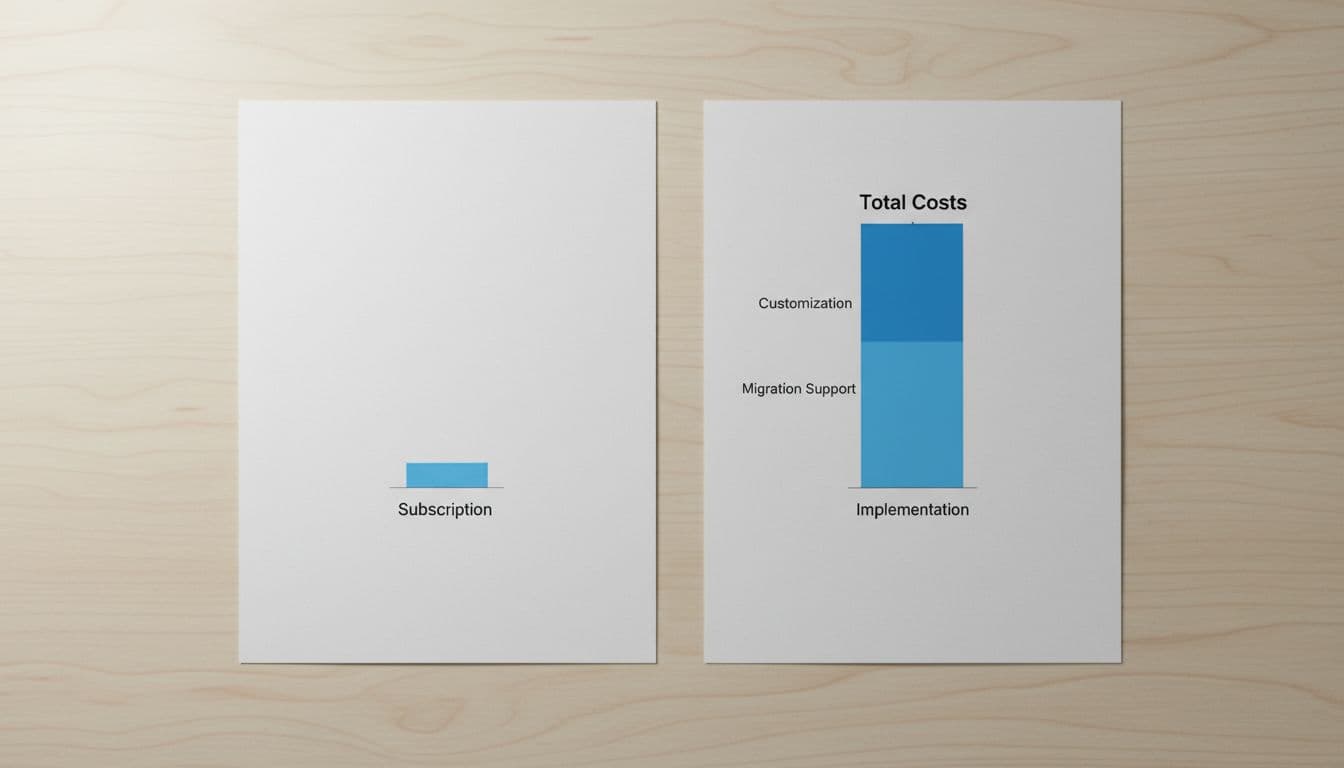
The subscription is usually the smallest clean number in the business case.
This is the simplest way to frame the cost stack:
| Cost layer | What the quote often shows | What the program often adds |
|---|---|---|
| Annual subscription | FUE-based fee, infrastructure, base support, some credits | escalators, true-ups, extra consumption, renewal uplifts |
| Migration and build | limited assumptions or credits | partner labor, data work, security redesign, testing |
| Custom and integration | basic scope | code remediation, APIs, middleware, BTP overages |
| Run and support | platform operations | AMS changes, release testing, dual-run, internal product ownership |
After signature, the real work begins. An independent 2026 pricing breakdown points out how escalators, BTP terms, and infrastructure assumptions can change the five-year view.
If the business case treats the subscription as the project budget, the missing cost will return later as change requests, overages, or renewal pressure.
The cost buckets that show up after signature
Implementation is the first shock. Even when a deal includes migration credits, those credits usually cover a narrow path. They rarely cover complex process redesign, heavy integration work, or a long stabilization period.
Data migration is another frequent miss. Moving clean master data is one thing. Rebuilding years of exceptions, local variants, and poor data quality is another. An independent migration cost guide for 2026 describes implementation and migration costs that can move from the low six figures into the millions, depending on scope, custom code, and timeline.
Custom code raises the bill faster than most steering committees expect. Clean-core goals may be sound, but code retirement, refactoring, and testing take time. The same is true for interfaces. A sales deck may assume standard integration. Your estate may include warehouse systems, tax engines, shop-floor tools, identity platforms, EDI links, and regional apps that need redesign.
Support costs also change shape. Under RISE, SAP manages more of the technical platform. Still, your internal support burden doesn’t vanish. It shifts toward process ownership, release testing, access governance, integration monitoring, and vendor coordination. During transition, many firms also fund dual support for legacy ECC and the new target platform.
Infrastructure is “included” only at a high level. In practice, resilience needs, non-production environments, storage growth, network architecture, and regional hosting requirements can push spend up. For a challenge model, this RISE total cost of ownership calculator shows how a five-year estimate can widen once overages, support, and integration are added. Use tools like this to pressure-test assumptions, not to replace your own model.
Because packaging and commercials vary in 2026, validate every line item with SAP and your partners before approval.
Cost scenarios that expose bad assumptions
Some projects still land close to the original case. Most don’t. The difference usually comes down to process fit and technical baggage.

A company with mostly standard processes and limited custom code may absorb RISE well. The subscription stays central, migration remains contained, and BTP use is modest. In that case, the bundle can reduce internal platform effort and bring clearer accountability.
A global ECC estate tells a different story. Local variants, custom workflows, bolt-on tools, and weak data discipline expand the program. Then testing grows, business change takes longer, and go-live support lasts longer than planned. The subscription may still look neat on paper, while the transformation budget stretches far beyond it.
Renewals create a third scenario. Year one may look acceptable, especially after discounting. Three years later, FUE growth, BTP consumption, and market-alignment language can make renewal cost much higher than the original model assumed. Public 2026 market references describe annual escalators around 2 to 4 percent in some contracts, while renewal uplifts can run much higher. That is where lock-in becomes a financial issue, not just an architecture issue.
Future flexibility matters for the same reason. If you later want to change scope, reduce users, switch service layers, or separate infrastructure choices from application choices, the contract may give you little room.
Questions to ask before signing or renewing
Use these questions to challenge the proposal before it hardens into a five-year commitment:
- What exactly is included in the annual subscription, and what triggers true-ups?
- How are FUEs calculated, and what user growth assumptions sit behind the quote?
- Which migration activities are funded, and which are partner-funded or excluded?
- How much custom code must be retired, rebuilt, or moved to BTP?
- What integration work is outside the base scope, including testing and security redesign?
- Which non-production, disaster recovery, and regional hosting needs change infrastructure cost?
- How does the support model change after go-live, including AMS, release testing, and dual-run periods?
- What are the renewal mechanics, price escalators, exit rights, and flexibility if usage drops?
These questions won’t slow the project. They reduce the odds of approving a clean commercial number with a messy financial outcome.
Conclusion
A RISE contract can tidy up how SAP is bought, but it doesn’t reduce the work needed to change an ERP estate. The real decision in 2026 is whether your model captures the full program cost, not only the subscription fee.
The strongest business cases separate recurring fees from one-time transformation spend, then test renewals, overages, and support changes under realistic conditions. If that math still works, the deal is far more likely to hold up after go-live.

