When auditors ask who controls your infrastructure supply chain, “it’s basically Terraform” no longer settles the issue. In 2026, OpenTofu vs Terraform is less about syntax and more about governance, support, and risk boundaries.
The short answer is simple. OpenTofu is often the better fit for regulated teams that want open governance, tighter control of state, and fewer licensing concerns. Terraform still makes sense when Terraform Cloud, Sentinel, and direct vendor support are already part of the operating model.
Why this choice moved from tooling to governance
Factually, both tools still look familiar. They share HCL, the plan and apply workflow, and broad provider compatibility. OpenTofu also remains close enough to Terraform that many teams can switch with little or no code change.
What changed is the frame around the tool. Terraform moved to the BSL in 2023, while OpenTofu stayed under MPL 2.0 and sits under Linux Foundation governance. In March 2026, that matters more because procurement, legal review, and long-term platform planning now sit next to engineering concerns. IBM’s ownership of HashiCorp adds another layer of vendor strategy that some enterprises welcome and others treat as concentration risk.
The ecosystem has also split in tone. Terraform still has the bigger installed base and the strongest first-party managed experience. OpenTofu, however, has moved past “just a fork.” A recent analysis of the fork’s maturity captures why the choice is no longer obvious for serious teams.
Think of it like choosing a rail system, not just a train. The day-to-day ride may feel similar, but control of the tracks, pricing, and operating rules shapes the whole trip.
Core differences in 2026 that affect compliance programs
For regulated teams, the strongest differences show up in security handling, policy controls, and platform fit.

OpenTofu has pulled ahead on a few built-in protections. Current releases add native state and plan encryption, plus ephemeral values that reduce the chance of sensitive data landing in state. That is a real benefit for finance, healthcare, and public-sector teams that treat state files like toxic waste. Terraform can still meet the same control goals, but it leans more on backend settings and surrounding platform services.
Here is the side-by-side view that matters most:
| Area | OpenTofu | Terraform | Why it matters |
|---|---|---|---|
| Governance | Linux Foundation, MPL 2.0 | HashiCorp under IBM, BSL | Licensing stability and procurement review |
| Security features | Native state and plan encryption, ephemeral values | More reliance on backend and platform controls | Secret exposure and evidence for control design |
| Policy as code | Commonly paired with OPA and partner platforms | Strongest with Sentinel in Terraform Cloud | Standard enforcement across teams |
| Support model | Community plus partner vendors | Direct vendor-backed support | Escalation path and accountability |
| Workflow fit | Best with self-hosted backends and open CI/CD | Best with Terraform Cloud and Enterprise | Audit trails, approvals, and operating model |
The practical takeaway is clear. OpenTofu gives more open control at the tool layer. Terraform gives more packaged governance if your team already runs inside HashiCorp’s managed world.
In regulated shops, the runner, backend, and approval flow matter as much as the IaC binary.
What regulated teams should optimize for, not just compare
Auditability rarely comes from the CLI alone. It comes from signed commits, protected branches, remote state controls, plan approvals, artifact retention, and ticket-linked change records. Both tools can support that pattern. The better choice depends on where those controls live today.
Terraform still wins when Sentinel, Terraform Cloud workspaces, private registry features, and vendor support contracts are already wired into enterprise workflows. In those setups, changing the binary is the easy part. Reworking governance is the expensive part.
OpenTofu pulls ahead when supply-chain risk and long-term maintainability drive the decision. Neutral governance helps boards and compliance teams because it lowers the chance of surprise licensing shifts. Self-hosted execution also fits organizations that don’t want state, plans, or policy checks tied to a single vendor boundary.
Ecosystem trends in 2026 point in the same direction. Terraform still has the larger ecosystem footprint. OpenTofu, however, keeps gaining support from platform vendors and is broadening its enterprise story without tying teams to one hosted control plane.
A balanced recommendation follows from that split. If your program values control and portability first, start with OpenTofu. If it values managed workflows and a direct commercial support line first, Terraform still has a strong case.
Migration readiness checklist for Terraform shops
Most migrations are not blocked by HCL. They are blocked by platform dependencies.
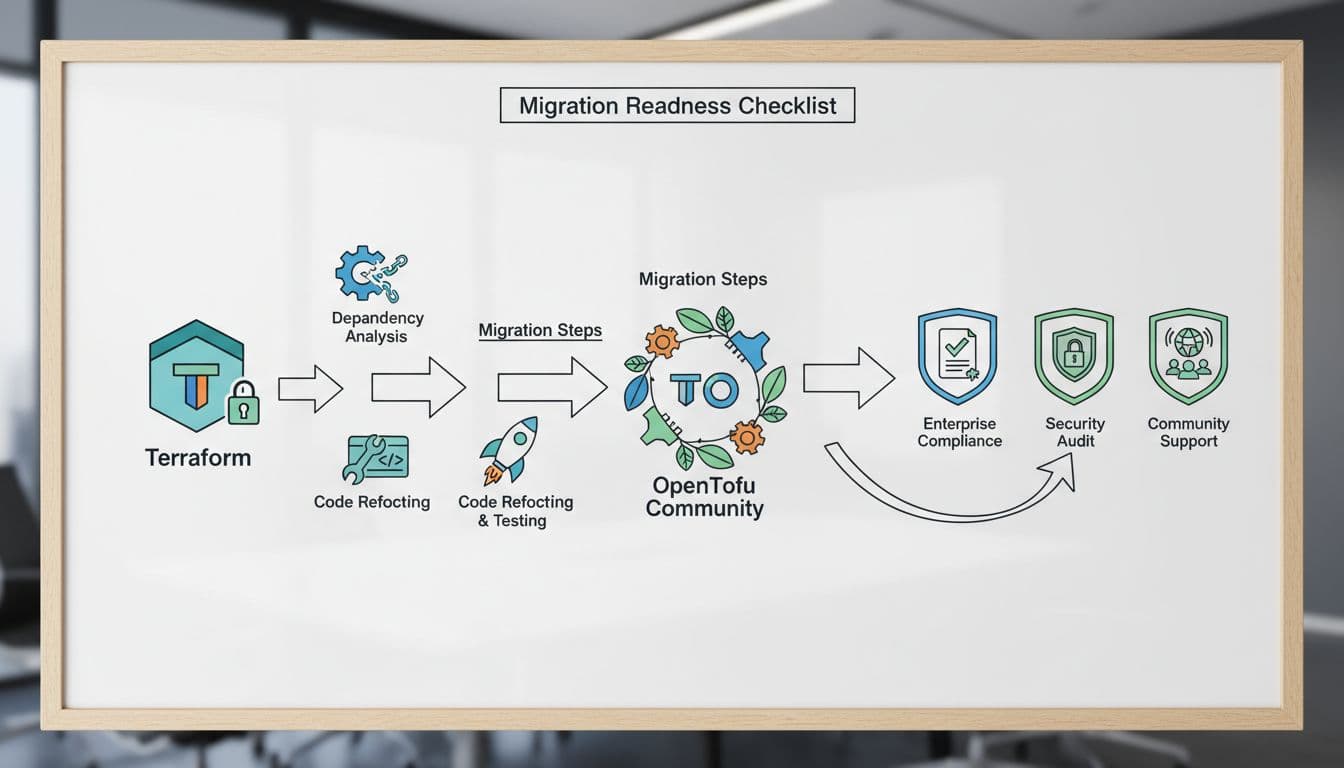
Use this short checklist before moving:
- Inventory control-plane dependencies: List Terraform Cloud workspaces, Sentinel policies, private module registries, and run tasks.
- Map policy replacements: If Sentinel is in scope, define an OPA or platform-based replacement before cutover.
- Review state handling: Confirm backend ownership, encryption, locking, retention, and break-glass access.
- Harden the supply chain: Pin provider versions, mirror providers if needed, and log checksum verification in CI.
- Test in one bounded domain: Migrate a low-risk stack first, then compare plan output, drift behavior, and approval logs.
For teams that use basic cloud backends and standard pipelines, migration can be fairly direct. A current Terraform to OpenTofu migration guide and a recent state migration walkthrough both show the operational steps clearly.
If you’re deep in Terraform Cloud and Sentinel, treat migration as a platform program, not a package swap.
Final take
For regulated enterprise teams in 2026, the best choice is the one that fits your governance model with the fewest exceptions. OpenTofu is the stronger default for organizations that want open control, lower licensing risk, and tighter ownership of state and execution. Terraform still earns its place where managed workflows, Sentinel, and direct vendor support already anchor compliance operations.

